


Page 39 - Demo
P. 39
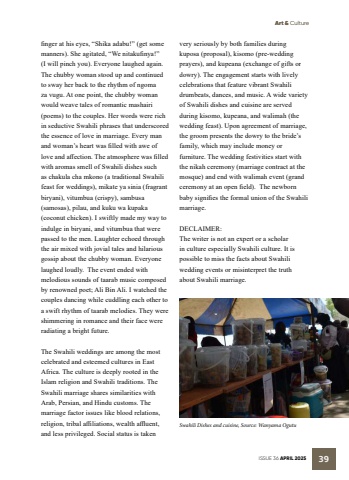
Art & CultureISSUE 36 APRIL 2025 39Art & Culturefinger at his eyes, %u201cShika adabu!%u201d (get some manners). She agitated, %u201cWe nitakufinya!%u201d (I will pinch you). Everyone laughed again. The chubby woman stood up and continued to sway her back to the rhythm of ngoma za vugu. At one point, the chubby woman would weave tales of romantic mashairi (poems) to the couples. Her words were rich in seductive Swahili phrases that underscored the essence of love in marriage. Every man and woman%u2019s heart was filled with awe of love and affection. The atmosphere was filled with aromas smell of Swahili dishes such as chakula cha mkono (a traditional Swahili feast for weddings), mikate ya sinia (fragrant biryani), vitumbua (crispy), sambusa (samosas), pilau, and kuku wa kupaka (coconut chicken). I swiftly made my way to indulge in biryani, and vitumbua that were passed to the men. Laughter echoed through the air mixed with jovial tales and hilarious gossip about the chubby woman. Everyone laughed loudly. The event ended with melodious sounds of taarab music composed by renowned poet; Ali Bin Ali. I watched the couples dancing while cuddling each other to a swift rhythm of taarab melodies. They were shimmering in romance and their face were radiating a bright future. The Swahili weddings are among the most celebrated and esteemed cultures in East Africa. The culture is deeply rooted in the Islam religion and Swahili traditions. The Swahili marriage shares similarities with Arab, Persian, and Hindu customs. The marriage factor issues like blood relations, religion, tribal affiliations, wealth affluent, and less privileged. Social status is taken very seriously by both families during kuposa (proposal), kisomo (pre-wedding prayers), and kupeana (exchange of gifts or dowry). The engagement starts with lively celebrations that feature vibrant Swahili drumbeats, dances, and music. A wide variety of Swahili dishes and cuisine are served during kisomo, kupeana, and walimah (the wedding feast). Upon agreement of marriage, the groom presents the dowry to the bride%u2019s family, which may include money or furniture. The wedding festivities start with the nikah ceremony (marriage contract at the mosque) and end with walimah event (grand ceremony at an open field). The newborn baby signifies the formal union of the Swahili marriage.DECLAIMER: The writer is not an expert or a scholar in culture especially Swahili culture. It is possible to miss the facts about Swahili wedding events or misinterpret the truth about Swahili marriage.Swahili Dishes and cuisine, Source: Wanyama Ogutu


