


Page 52 - Demo
P. 52
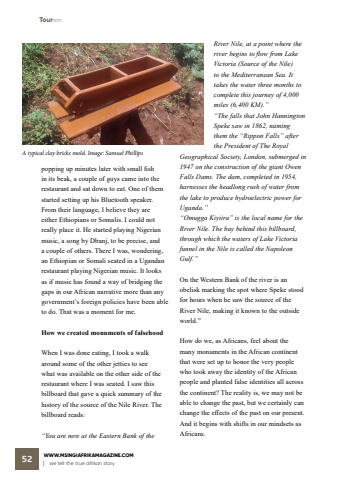
TourismWWW.MSINGIAFRIKAMAGAZINE.COM | we tell the true afrikan story 52popping up minutes later with small fish in its beak, a couple of guys came into the restaurant and sat down to eat. One of them started setting up his Bluetooth speaker. From their language, I believe they are either Ethiopians or Somalis. I could not really place it. He started playing Nigerian music, a song by Dbanj, to be precise, and a couple of others. There I was, wondering, an Ethiopian or Somali seated in a Ugandan restaurant playing Nigerian music. It looks as if music has found a way of bridging the gaps in our African narrative more than any government%u2019s foreign policies have been able to do. That was a moment for me.How we created monuments of falsehood When I was done eating, I took a walk around some of the other jetties to see what was available on the other side of the restaurant where I was seated. I saw this billboard that gave a quick summary of the history of the source of the Nile River. The billboard reads:%u201cYou are now at the Eastern Bank of the River Nile, at a point where the river begins to flow from Lake Victoria (Source of the Nile) to the Mediterranean Sea. It takes the water three months to complete this journey of 4,000 miles (6,400 KM).%u201d%u201cThe falls that John Hannington Speke saw in 1862, naming them the %u201cRippon Falls%u201d after the President of The Royal Geographical Society, London, submerged in 1947 on the construction of the giant Owen Falls Dams. The dam, completed in 1954, harnesses the headlong rush of water from the lake to produce hydroelectric power for Uganda.%u201d%u201cOmugga Kiyiira%u201d is the local name for the River Nile. The bay behind this billboard, through which the waters of Lake Victoria funnel in the Nile is called the Napoleon Gulf.%u201dOn the Western Bank of the river is an obelisk marking the spot where Speke stood for hours when he saw the source of the River Nile, making it known to the outside world.%u201dHow do we, as Africans, feel about the many monuments in the African continent that were set up to honor the very people who took away the identity of the African people and planted false identities all across the continent? The reality is, we may not be able to change the past, but we certainly can change the effects of the past on our present. And it begins with shifts in our mindsets as Africans.A typical clay bricks mold. Image: Samuel Phillips


